
Future Genie
“A next-generation analytics platform built for modern traders.”
A marketing site, an authenticated analytics portal and a Flask API with a live scheduled screener — the whole Future Genie product.
- Sector
- Trading / Analytics
- Engagement
- 2026
- Scope
- End to end
- Live
- futuregenie.in
Overview
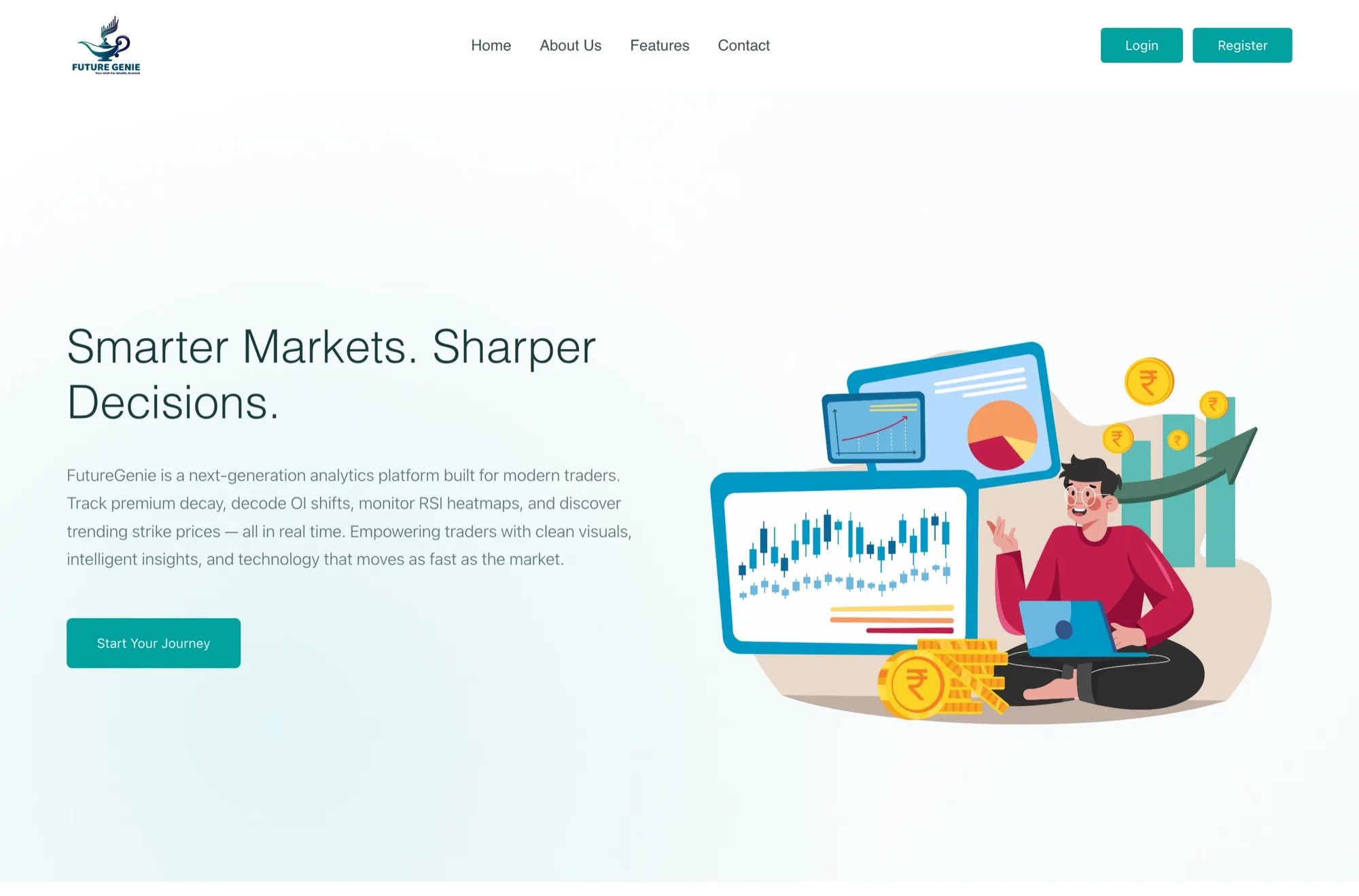
Future Genie is a trading-analytics product with a public Angular marketing site, a separate authenticated Angular portal carrying 20+ analytics dashboards, and a Flask API that composes market data into scored, opinionated outputs.
We built the portal's signature engines — a Weighted Strength Engine, a Market Summary outlook score, OI Intelligence, Premium Decay, RSI dashboards — plus a weekday scheduler that runs Gann and demand/supply stock scans at 3:30pm and an admin surface for tuning the index weights those engines depend on.
The brief
A data feed anyone can buy, turned into a view
Future Genie sells itself as a next-generation analytics platform for modern traders — a place to read premium decay, decode open-interest shifts, watch RSI heatmaps and spot trending strikes as they move. Every serious trading tool starts from the same raw market feed; the product is what you do with it.
What Future Genie does with it is score it. The portal's signature engines compose participant positioning, option-chain pressure, OI intelligence, trending OI and premium decay into gauge cards and one bounded market-outlook number, so a trader gets a read, not a spreadsheet.
Algotrax built the whole thing: the public Angular marketing site, the separate authenticated Angular portal with more than twenty analytics dashboards, the Flask API that does the composing, the weekday scheduler that runs the stock scans, and the admin surface for tuning the weights the engines depend on.
Architecture
A marketing site, a portal, and an API with opinions
Three codebases: an Angular 22 marketing site, an Angular 20 portal built on PrimeNG with ApexCharts, ECharts and Lightweight Charts, and a Flask-RESTX API over MongoDB — nine collections — with JWT auth, a token blocklist, request logging and Swagger docs.
It runs as two systemd services, not one: the API on Waitress, and a separate scheduler process for the timed jobs. The front end is on Vercel. The portal's dashboards map compressed API responses straight to charts, drive live updates over Socket.IO, and hold replay and end-timestamp state so a trader can scrub back through the session.
The scoring engine
Composing six feeds into one number
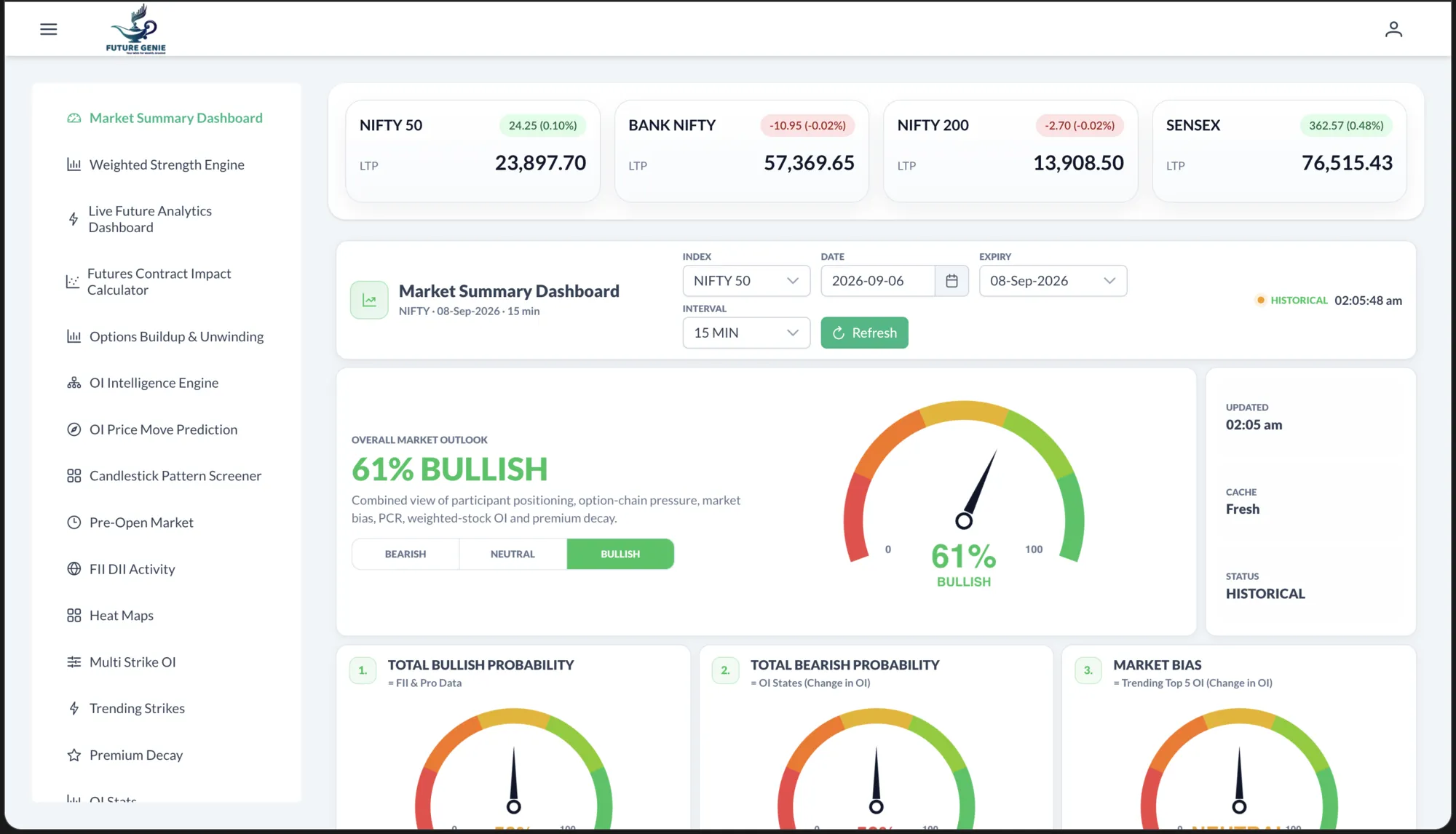
The Market Summary engine is the heart of the product. It pulls participant OI, the option chain, OI intelligence, trending OI, premium decay and weighted-strength payloads, and composes them into gauge cards and a single overall outlook score — bounded 0 to 100, labelled bullish, neutral or bearish.
Inside that are PCR scoring, ratio scores and bias labels, and explicit handling for the case a trader never sees in a demo: a source is unavailable. The score degrades gracefully rather than lying, and it caches on a market clock — a shorter TTL while the market is open, a longer one after close, so live users get fresh numbers and the data provider isn't hammered overnight.
The same composition idea repeats at the desk level. OI Intelligence, OI Price-Move Prediction and Options Buildup & Unwinding each take the raw option chain and turn it into a force reading, an expected-move estimate and a confidence band — framed honestly as an estimate, not a promise.
The score degrades gracefully rather than lying when a source drops out — and it caches on a market clock.
Weighted strength
The engine that runs on tuned weights
The Weighted Strength Engine measures which stocks are actually driving an index. Index weights are configuration — set and tuned in the admin console — and the engine normalises those weight documents, validates that active weights are positive, and fetches weighted price moves (falling back to plain quotes when the weighted feed is down).
From there it computes a per-stock score of weight times change percent, rolls that into bullish, bearish and net strength, attaches a bias label, and returns a sorted list of contributors. It is a small, legible piece of maths — which is exactly why it's trustworthy.
The scheduler
A screener that only runs when the market does
One process on the box does nothing but wait for 15:30 on a weekday. When it fires, the custom screener scans NSE stocks pulled from Yahoo Finance for Drop-Base-Rally and Rally-Base-Drop patterns — using wide-body, small-body and proximity thresholds — cleans the symbols, formats the rows, and upserts the day's scan. It loops on a thirty-second cadence while it's active.
Alongside it, a Chartink webhook accepts posted screener payloads — stocks, trigger prices, scan names — and feeds the RSI stocks and options dashboards, so a trader's own Chartink alerts land inside Future Genie.
The portal
Twenty-plus reads on the same market
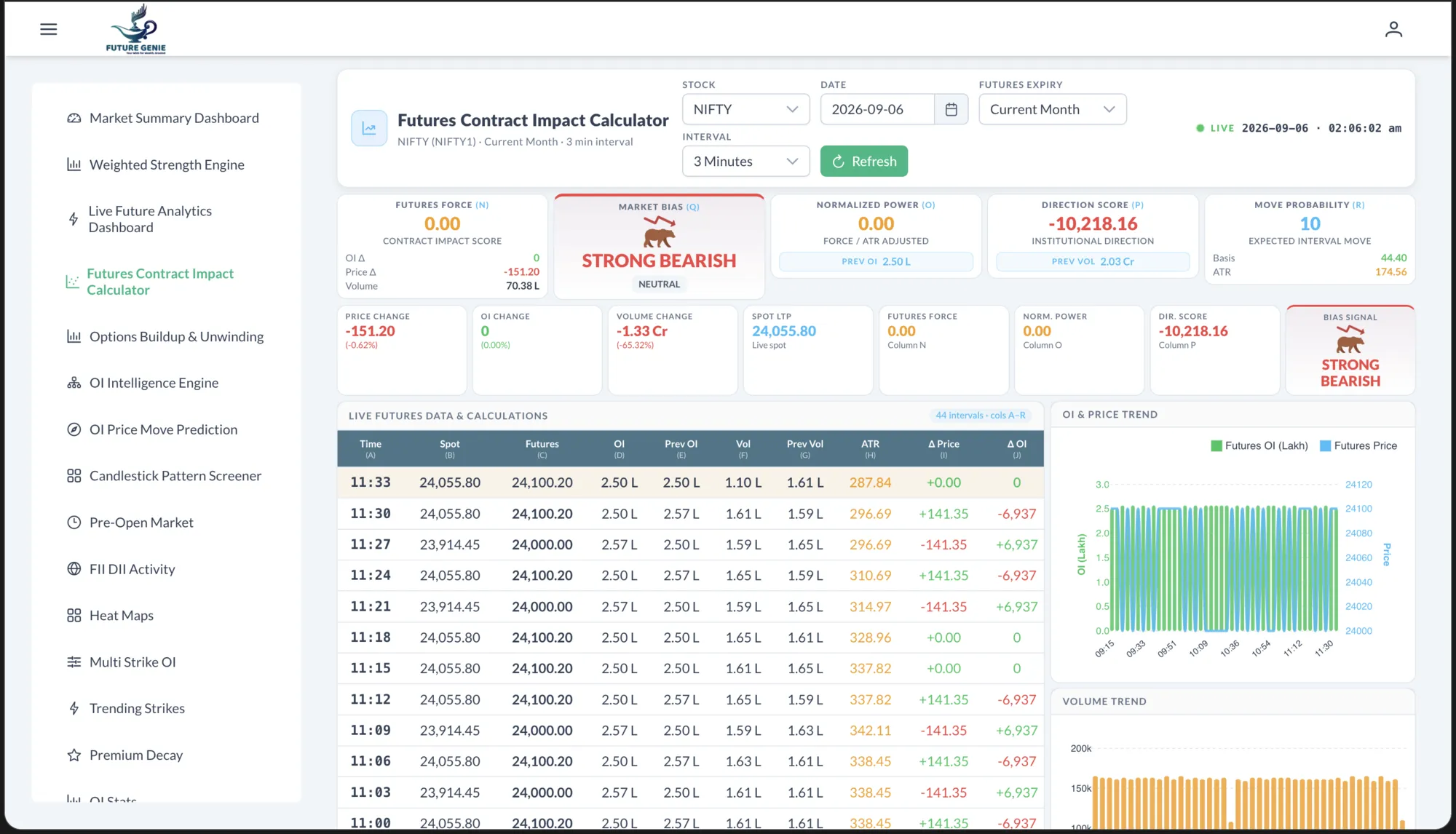
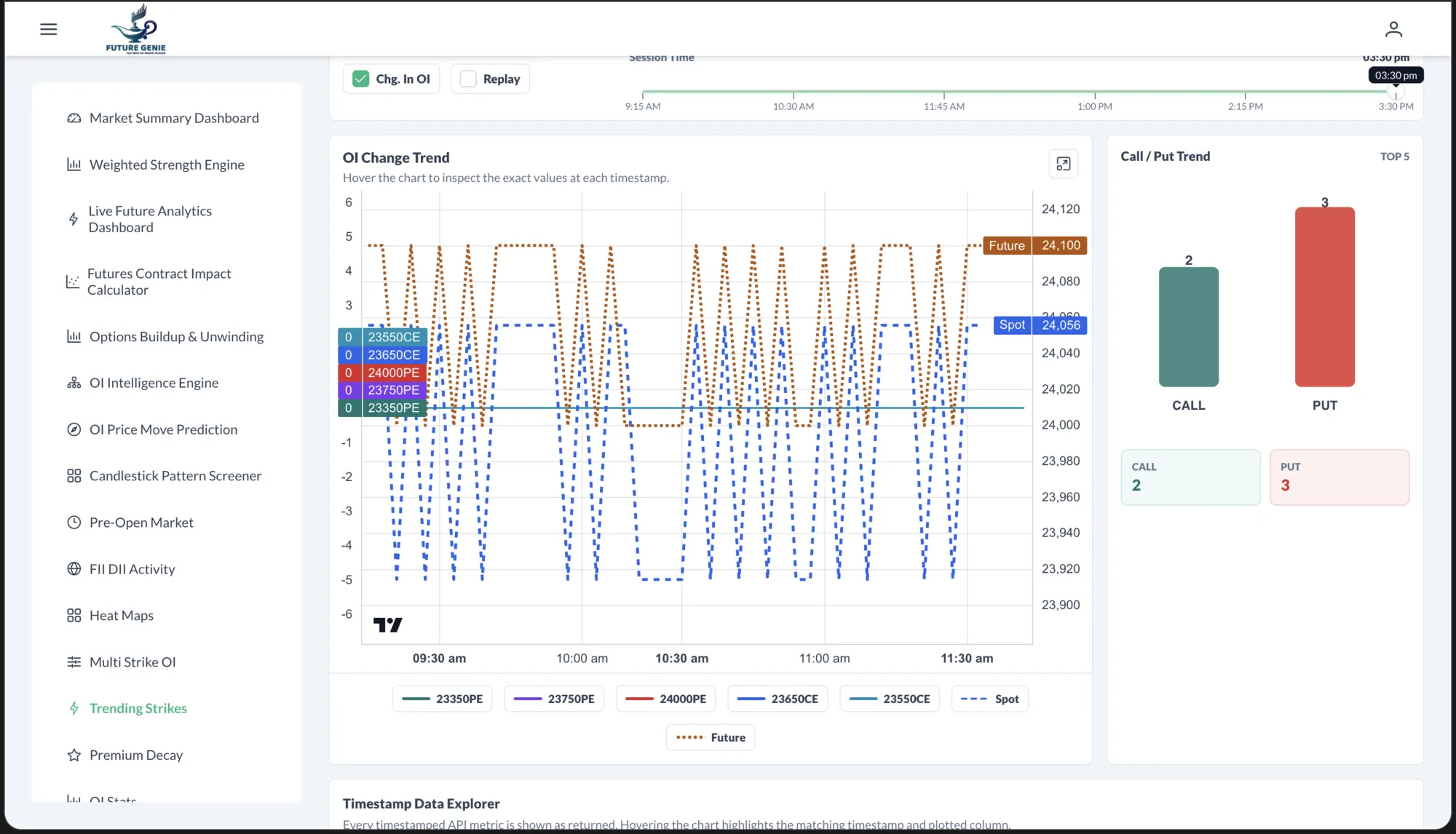
The engines feed a wide portal: OI Intelligence, OI Price-Move Prediction, Options Buildup & Unwinding, Premium Decay, RSI stocks and options dashboards, Multi-Strike OI, Trending Strikes, the Futures Contract Impact Calculator, Pre-Open Market, FII/DII Activity, Heat Maps, and a full paper-trading module.
Paper trading needs no second signup: a per-user practice password is derived from a shared secret, the account is registered against the shared paper-trade service on the first miss, tokens are cached, and auth failures are retried transparently.
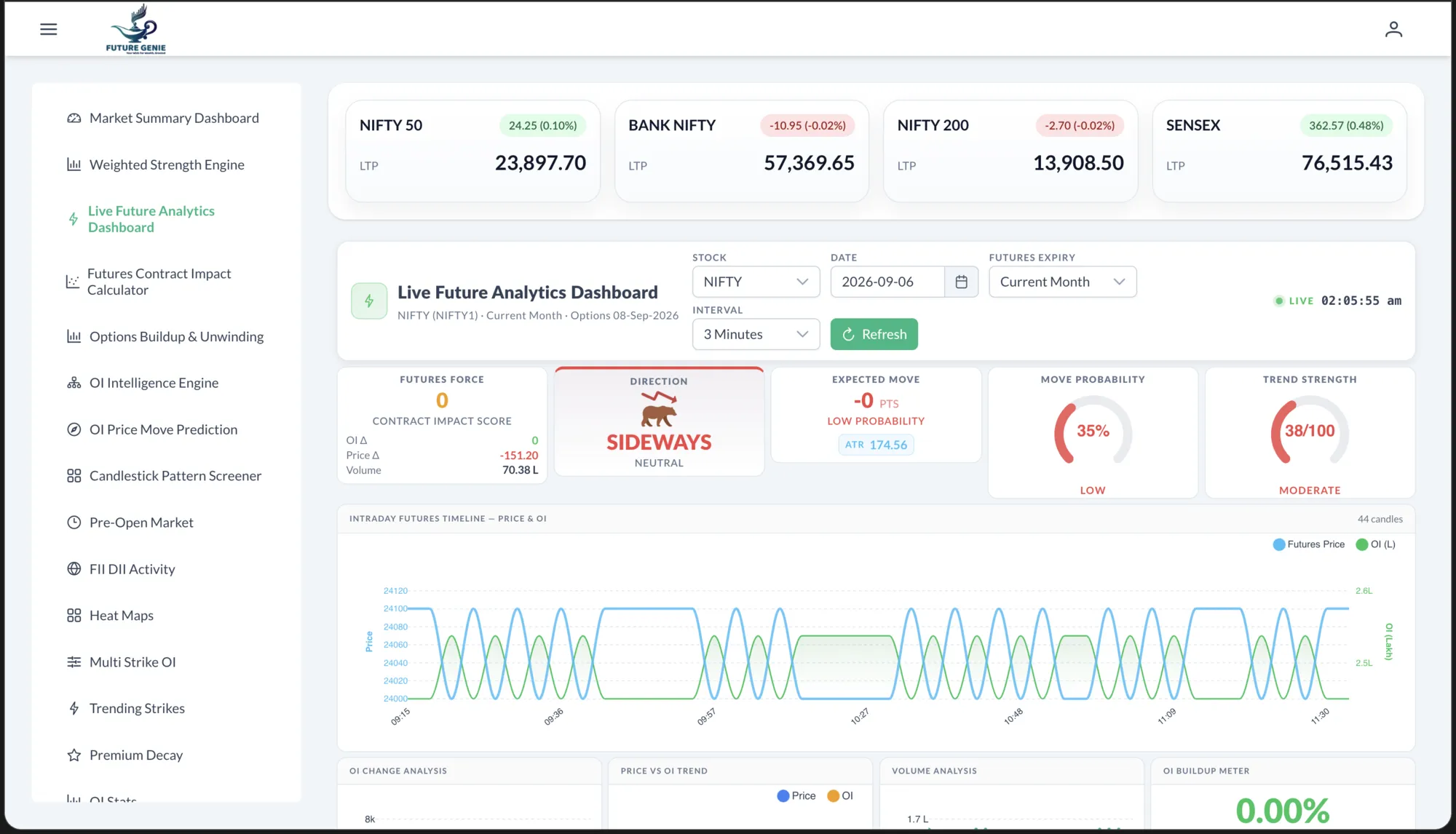
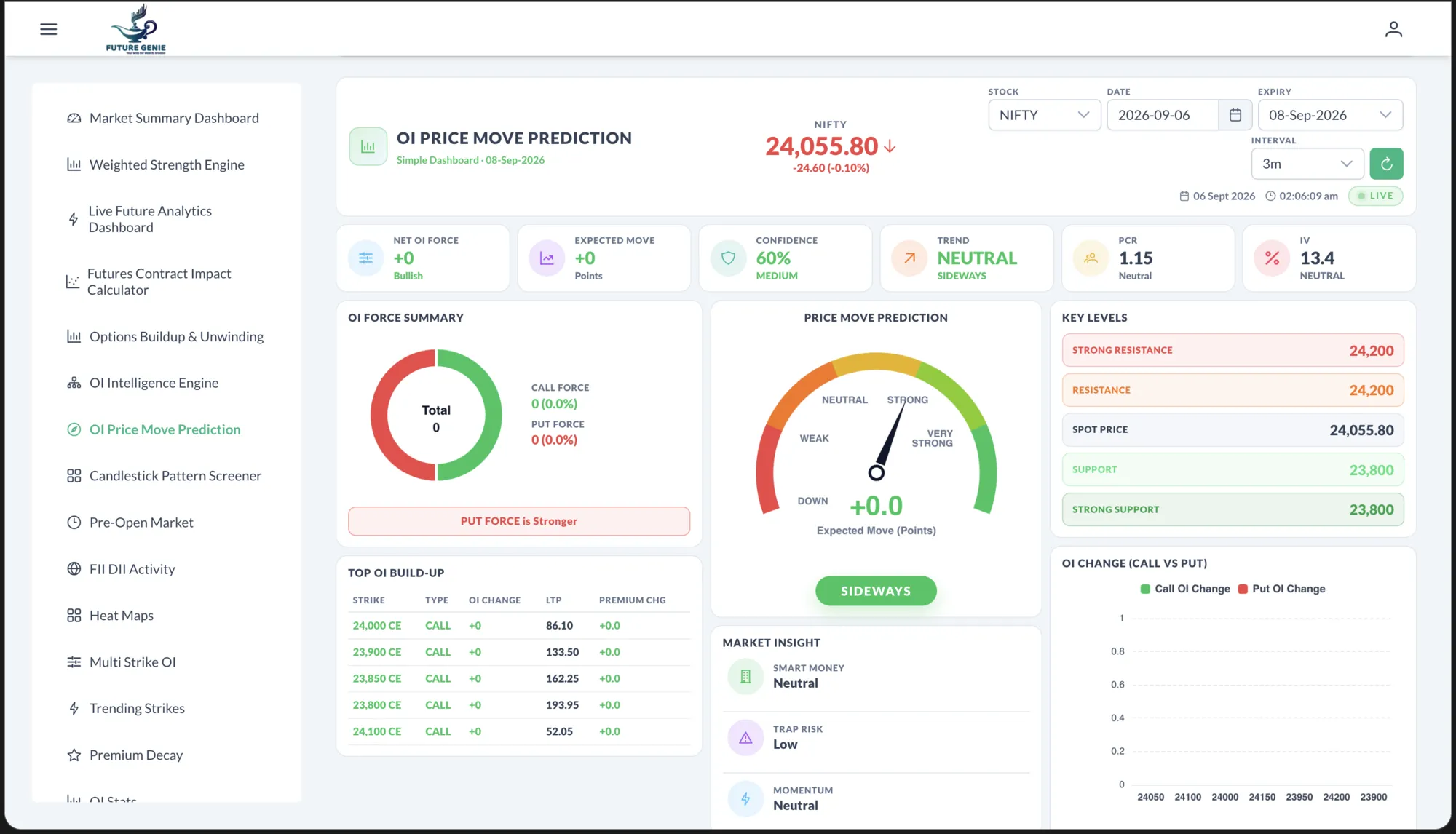
The engineering you don't see in a demo.
Turning a data feed into an opinion
The Market Summary engine composes participant OI, option-chain, OI intelligence, trending OI, premium decay and weighted-strength payloads into gauge cards and one overall outlook score — with PCR scoring, ratio scores, bias labels, bounded 0–100 outputs and explicit handling for when a source is unavailable.
A screener on a market clock
The custom screener runs only on weekdays at 15:30, scans NSE stocks from Yahoo Finance for Drop-Base-Rally and Rally-Base-Drop patterns using wide-body / small-body / proximity thresholds, then cleans symbols and upserts daily scan rows.
Cache TTLs that know the time
Weighted-strength and market-summary caches use different TTLs during market hours versus after close, so live users get fresh numbers and off-hours load doesn't hammer the data provider.
What it runs on.
Measured from the repository, not the pitch.
FutureGenie helped me spot premium decay and OI shifts before they played out. It's now part of my daily workflow.
Sagar · Options Trader
Committed in the client's repository
Against the baseline.
Reported as change against the engagement baseline. Search figures stay as percentages and multiples on purpose — absolute volume tracks Future Genie's news and category cycle, so the relative move is the honest measure.
Scope, stack, scale and the engineering above are drawn straight from Future Genie's codebase and git history.
The takeaway
One team from the landing page to the scan job
Future Genie is a 2026 engagement, and in 247 days it went from nothing to a marketing site, a twenty-dashboard portal, a scoring API and a scheduled screener — all on one roadmap.
The traffic and subscription numbers belong to Future Genie. What we can point at is the machinery: engines that turn a commodity data feed into an opinion, and the discipline to keep them honest when a feed drops out.