DevOps & Hosting
Infrastructure, deployment pipelines, and cloud architecture for products where downtime and slow releases are the actual cost centre.
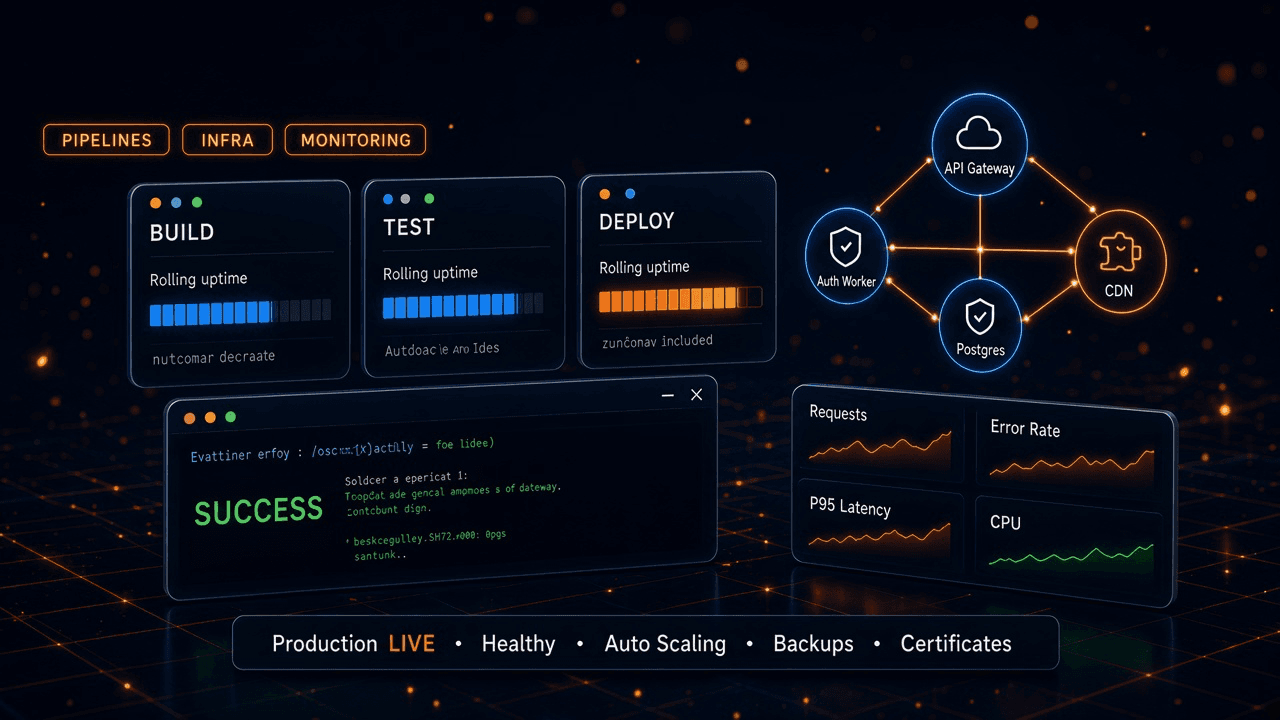
Most small and mid-size engineering teams don't have a DevOps problem until the day they very suddenly do — a deploy that takes down production because there was no pipeline to catch the mistake, a database that hits a scaling wall during the one week of the year traffic actually matters, a cloud bill that's quietly tripled because nobody's looked at what's actually provisioned versus what's used.
Infrastructure is the discipline that's invisible when it's working and catastrophic when it isn't — which is exactly why it's the first thing an under-resourced team defers.
The cost of deferring isn't hypothetical: downtime during a launch, a slow release cycle that makes every feature take longer to ship than the code itself warranted, or a security gap that sits open because nobody owns finding it.
Algotrax treats infrastructure as an engineering discipline with its own deliberate decisions, not a checkbox handled by whichever engineer drew the short straw.
What's included
CI/CD pipeline setup — every merge ships without a manual deploy ritual
Cloud architecture on AWS/GCP/Vercel, sized to actual load, not guesswork
Monitoring and alerting so problems surface before a client reports them
Database scaling, backups, and disaster-recovery planning
Cost audits — a large share of cloud spend on small teams is idle overprovisioning
How it actually runs
Infrastructure audit
What's actually running, what it costs, and where the real risk sits — before recommending any change.
CI/CD pipeline setup
Every merge to main ships through a tested, automated pipeline — no manual deploy rituals that depend on one person remembering the steps.
Architecture sized to real load
Cloud resources provisioned against actual traffic patterns and growth plans, not a guess padded "to be safe" that quietly triples the bill.
Monitoring & alerting
Problems surface to a real person before a client reports them — the difference between catching an incident in minutes versus hours.
Documentation & handoff
Everything documented clearly enough that your own team can operate it, whether or not the engagement continues.
Built with
What most agencies get wrong here
Provisioning "to be safe" instead of to actual load.
The single biggest driver of wasted cloud spend on small teams — resources sized for a traffic spike that isn't coming.
Treating monitoring as optional until after the first outage.
Alerting that doesn't exist yet is the reason the team finds out about problems from angry customers instead of a dashboard.
No deploy pipeline, so every release depends on tribal knowledge.
The bus-factor problem: one person leaves, and the deploy process leaves with them.
Skipping documentation because "we'll remember."
Nobody remembers the reasoning behind an infrastructure decision six months later — least of all the person who made it.
How the engagement works
Infrastructure audits are typically scoped as a short, fixed-price engagement first — a clear picture of what's there and what's actually worth fixing, before committing to bigger work.
Setup projects — CI/CD, monitoring, architecture changes — run as fixed-scope work against a documented plan, handed off with real documentation your team can operate independently.
Teams that don't want to staff DevOps in-house often move to an ongoing arrangement instead — the same team staying on infrastructure the way an internal hire would, without the internal hire.
Once the pipeline is in place, deploys stop being an event — releases ship routinely, monitored automatically, without depending on one person's Tuesday afternoon being free.
Getting started is the infrastructure audit — a clear picture of what's running, what it costs, and what's actually worth fixing first.
Tell us where devops & hosting fits in, and we'll reply within a day.
- A real person reads this, not a queue
- No discovery call required to get a straight answer
- Tell us to go away and we will — no drip sequence
Questions worth asking first
Yes, with an audit first — inherited infra is common, and most of the time it's fixable without a full rebuild.