SaaS Product Development
Full-cycle SaaS product development — for founders taking a product from an idea to something people pay for and depend on.
Most SaaS products don't fail because the code was bad — they fail because the team spent six months building features nobody asked for before finding out whether anyone would actually pay for the core idea. By the time the real signal arrives, the runway to act on it is gone.
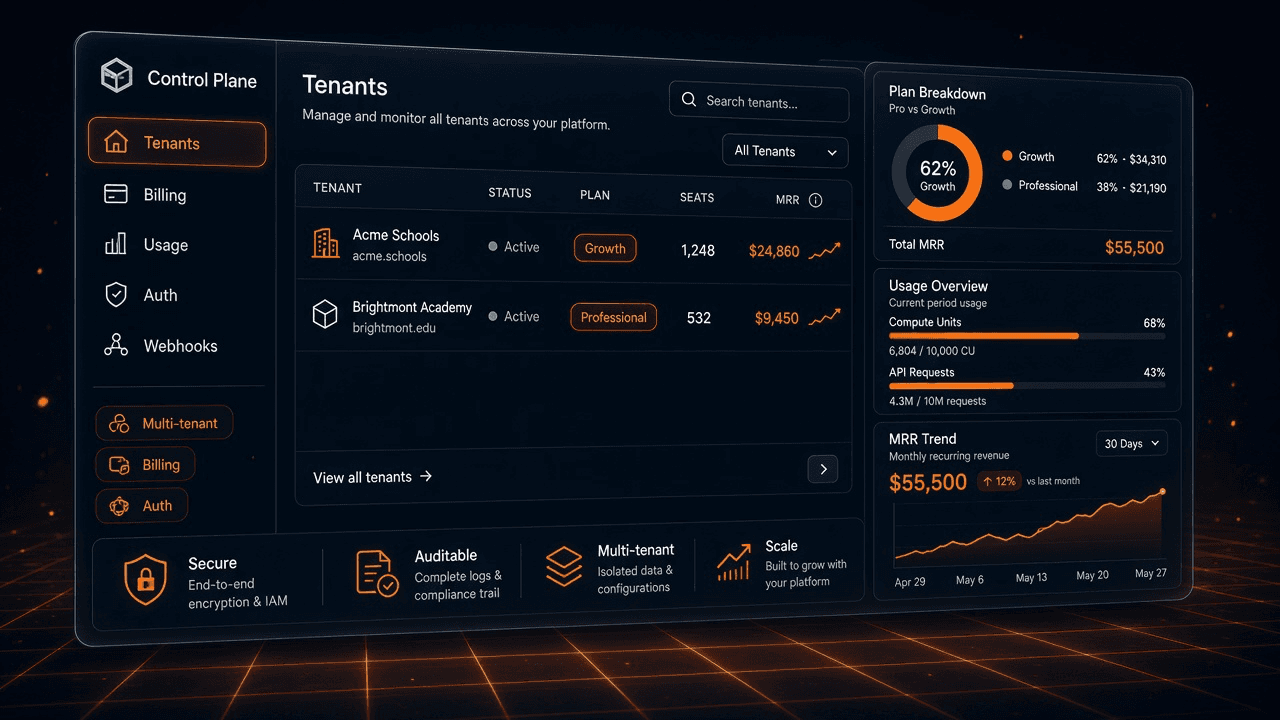
On the other end of the mistake: teams that validate fast with a scrappy MVP, then can't scale it, because auth, billing, and multi-tenancy were never designed in — they were duct-taped on after the first paying customer, and every customer after that inherits the duct tape.
Both failure modes come from the same root cause: treating "build the MVP" and "build it to scale" as sequential problems instead of one continuous discipline from day one.
Algotrax builds SaaS products to prove the hypothesis fast without betting the architecture on the assumption that scale will never come.
What's included
MVP scoping — the smallest version that proves the actual business hypothesis
Multi-tenant architecture, billing, and auth built in from the start, not bolted on later
Iterative build cycles with real usage data driving what gets built next
Infrastructure that scales without a rewrite at the first traffic spike
The same team through MVP, growth, and scale — no re-hire, re-explain cycle
How it actually runs
Hypothesis & MVP scoping
The smallest version of the product that actually tests whether people will pay — not the smallest version that's easy to build, which is a different (and common) mistake.
Foundational architecture
Multi-tenancy, auth, and billing designed in from the start — the parts that are genuinely expensive to retrofit once real customer data depends on them.
Build & ship the MVP
A working, paid-signup-ready product, not a demo — because the whole point is testing willingness to pay, not willingness to click a prototype.
Usage-driven iteration
Once real users are in the product, what gets built next is driven by how they actually use it, not the original roadmap guess.
Scale readiness
Infrastructure and architecture reviewed against real growth, before a traffic spike forces an emergency rewrite instead of a planned one.
Built with

What most agencies get wrong here
Building the roadmap before the MVP proves the hypothesis.
Months of feature work on a product nobody's confirmed anyone will pay for.
Retrofitting multi-tenancy after the first few customers.
What should be an architectural decision becomes an emergency migration with live customer data on the line.
Choosing infrastructure for the growth you hope for, not the stage you're actually at.
Over-engineering for scale that may never arrive burns runway just as surely as under-engineering does.
Treating billing as a checkbox integration.
Stripe or Razorpay is the easy part; the actual complexity is pricing logic, proration, upgrades/downgrades, and dunning — the parts that show up the first time a customer wants to change plans.
How the engagement works
MVP engagements are scoped tightly around the specific hypothesis being tested — the goal is answering the question fast, not building every feature on the eventual roadmap.
From MVP onward, most SaaS clients move to a retainer-style engagement rather than a series of separate fixed-scope projects, since the roadmap keeps evolving with usage data and a rotating team would keep losing that context.
Infrastructure and billing are priced to reflect actual complexity — a single-tenant MVP with simple billing is a different scope than a multi-tenant platform with usage-based pricing from day one, and we'll be specific about which one your product needs.
Once the MVP is live, the roadmap stops being internal debate and starts being usage data — what real, paying customers actually do in the product decides what gets built next.
Getting started means being honest about the hypothesis being tested — the sharper that's defined, the tighter and faster the MVP that tests it.
Tell us where saas product development fits in, and we'll reply within a day.
- A real person reads this, not a queue
- No discovery call required to get a straight answer
- Tell us to go away and we will — no drip sequence
Questions worth asking first
Yes. A code and architecture audit first, so you know honestly what's worth keeping before we touch anything.